Understanding the Guitar
Congrulations on starting this journey! The guitar is a wonderful and easy-to-learn instrument, and I hope you’ll have as much fun as I did learning how to play it.
You won’t need a specific type of guitar for this course, as long as you have one! The interactive examples will use sound samples from an acoustic guitar, though. Later, as we cover techniques like slides and bends, you might find that having specific kinds of strings is more useful - but you should be able to practice these techniques on most strings.
This lesson will cover a few key terms that will help you along the way.
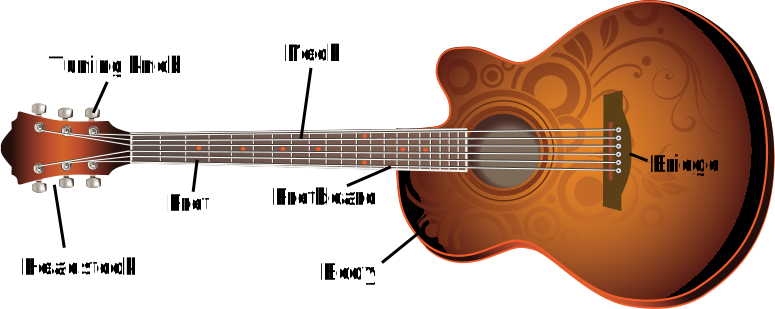
Broadly speaking, a guitar consists of a body, a neck and the headstock. There are six strings (numbered 1 (the thinnest) to 6 (the thickest)), which run from the bridge (located on the body) to the headstock, where it is wound up in pegs. These pegs can be tuned via the knobs on the headstock.
There is a board that runs along the neck and part of the body. This is the fretboard. It is divided into sections (the exact number depends on the guitar you have) called frets.
To play a sound, press on one of the strings at a specific fret, and play that string. You will notice that the sound is higher-pitched the further down the neck you go. We’ll look at why this happens in the next lesson.