Music Theory 1 - Notes, Scales and Intervals
Before we begin
As I mentioned earlier, this course will be split into two sections - the practical, guitar-oriented section and the music theory section.
It may sound dry, but music theory is incredibly useful. If you’ve ever asked yourself the following questions:
Why does this music sound good?
How do I play music like this?
How do I play along with it?
Music theory can give you the answers.
Music theory is also instrument-agnostic. This means you can apply the same theory to play any kind of instrument. That doesn’t mean you can play it well, of course - that takes practice. But theory will help you play correctly (for some vague definition of correct).
That brings us to my next point. In this lesson (and all future lessons), I will use Music Theory to refer to Modern Western European Music Notation, one of many musical traditions around the world. What makes it special is that nearly all Western music (AKA music with guitars) is written using this notation, making it a good starting point. There are many other musical traditions, many of which are completely different from the Western European one, and I encourage you to explore them as well.
Final note: Music theory is vast, and covers a lot of things we don’t really need to play guitar. Unless it’s especially interesting, I will skip over the topics we don’t need.
The Basics
Notes
A note refers to sound at a specific frequency. A note with exactly twice the frequency of another note is said to be an octave above the other note.
Scales
A Scale refers to any group of notes that spans an octave.
The Chromatic Scale
The foundational scale in western music is the Chromatic Scale, and it consists of 12 notes. For convenience, we refer to these notes with letters rather than frequencies. The notes in the chromatic scale are:
- C
- C#
- D
- D#
- E
- F
- F#
- G
- G#
- A
- A#
- B
- C (an octave higher)
I’ll explain what the ‘#’ means in the next section.
Intervals
An interval refers to the distance between two notes. The intervals between two adjacent notes on the chromatic scale is called a semitone or half-step. Two semitones make a whole tone or whole step.
Sharps and Flats
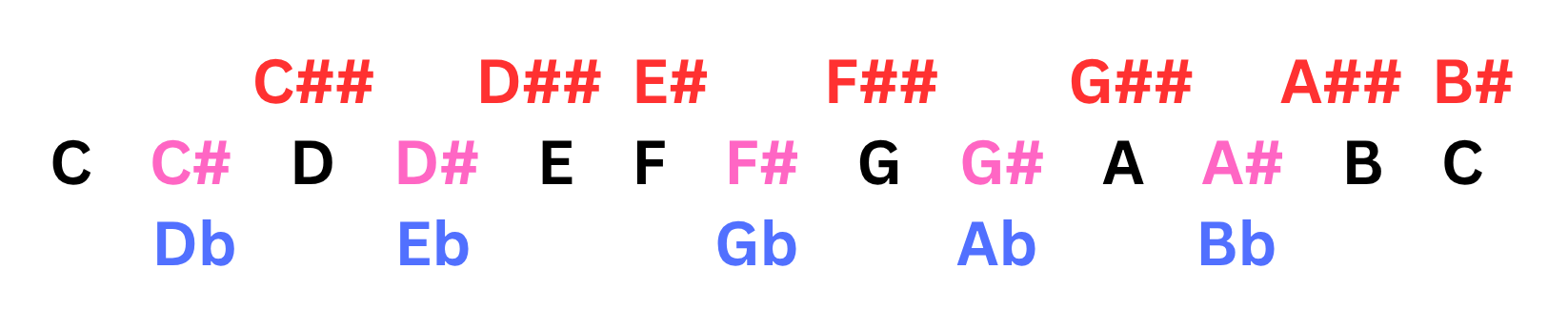
A # (‘sharp’) raises a note by a semitone eg. C# refers to C raised by a semitone. Sharps can be chained eg. C## is C raised by two semitones - which is D. Note that there are no E# or B# notes - these exist, but they’re the same as F and C respectively.
Similarly, a ♭ (‘flat’) (often written as a lowercase ‘b’) lowers a note by a semitone eg. G♭ refers to G lowered by a semitone, which is the same as F#. They can be chained just like sharps.
This means that, theoretically, there are infinite ways of representing a note: \(E = F\flat = D\sharp\sharp = G\flat\flat\flat = \dots\)
The following figure should help: